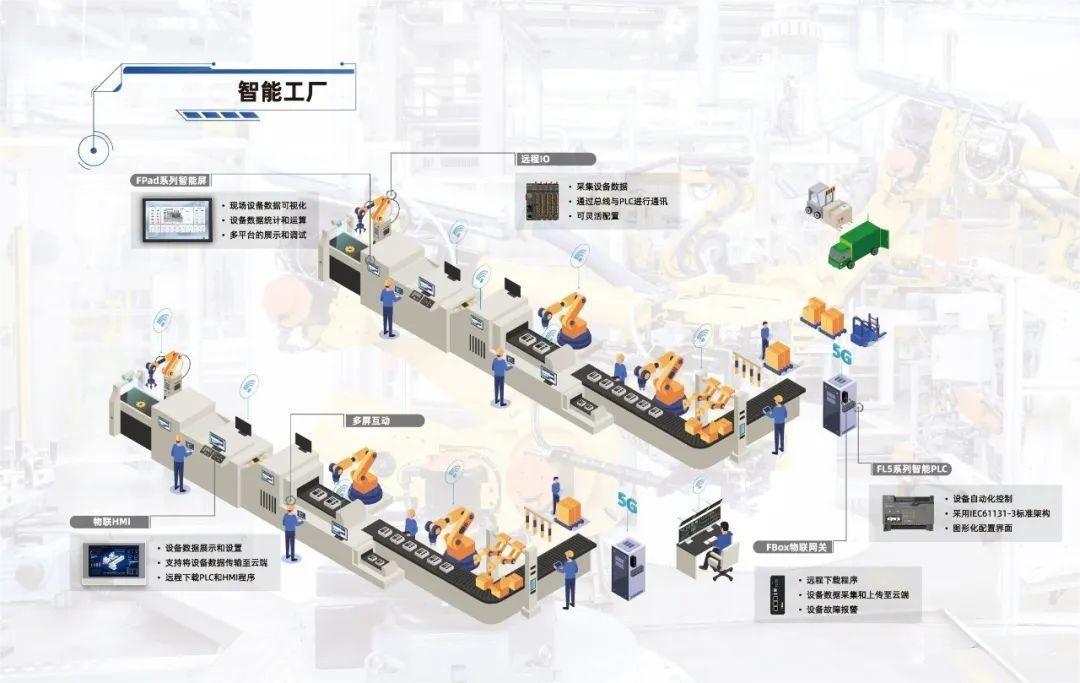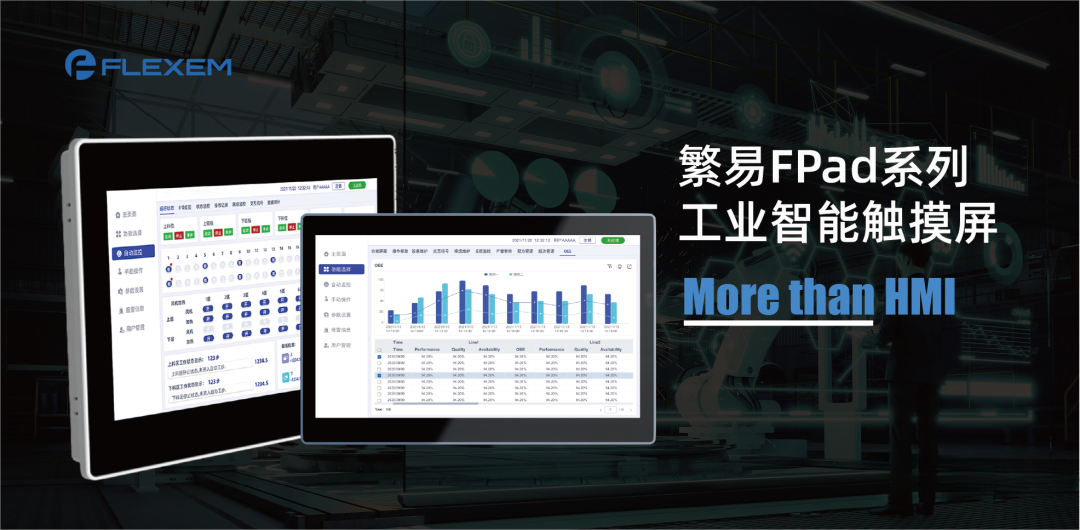
With the acceleration of the process of equipment intelligence, advanced intelligent control technology has been widely used in many scenes of equipment site. In order to meet the needs of more high-end manufacturing customers, Flexem launched the FPad series of industrial intelligent human-machine interface.
The F Pad series HMI (hereinafter referred to as FPad) products are designed for high-end manufacturing scenarios. They are based on Web architecture design, use Linux operating system, and support Python script running. While consolidating and iterating the traditional industrial HMI field applications, they are endowed with information system (MES, ERP) docking, equipment edge side data analysis and AI intelligent computing capabilities. From the underlying technical architecture to the HMI functional application, it is completely renewed. It provides a new generation of equipment-side industrial HMI intelligent solutions for a large number of equipment OEMs and terminal sites.
Five advantages
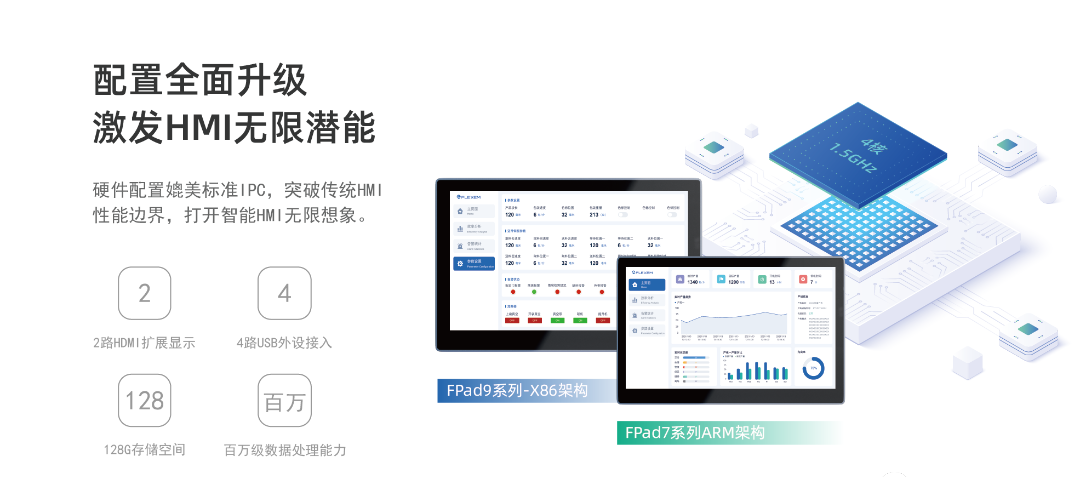
F Pad supports a variety of application scenarios, has a comprehensive configuration upgrade, and its hardware configuration is comparable to that of a standard IPC. It breaks through the performance boundaries of traditional HMIs and stimulates the innovative potential of industrial HMIs.
Overall performance improvement
Naturally based on the web
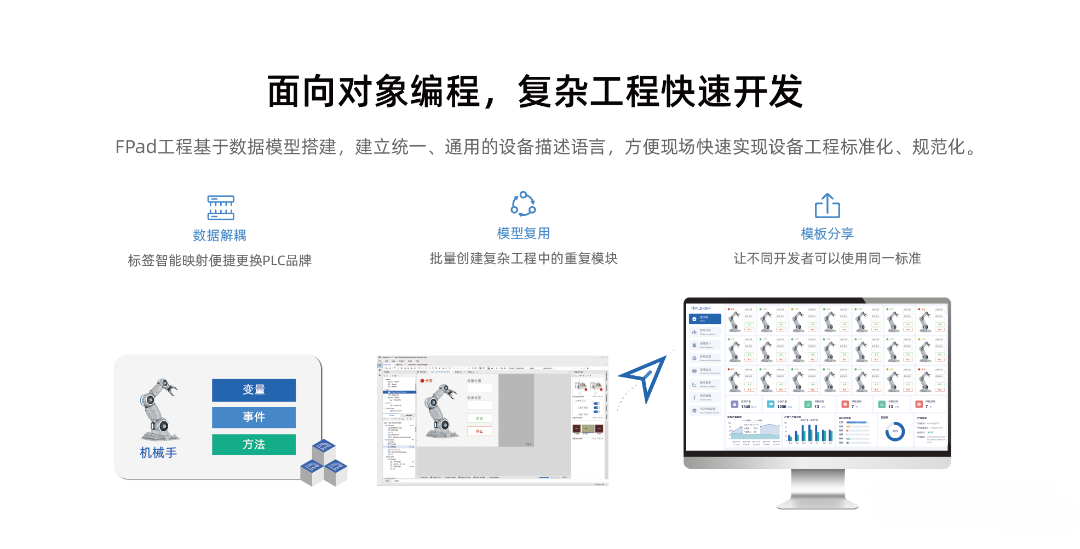
Object-Oriented Programming
Everything is a "model". FPad can abstractly model devices and decouple them from PLC hardware, allowing users to freely define and design data models for field devices.
On top of the data model, users can quickly encapsulate standardized modules in the project and use them in batches through functions such as FPad object view and repeater. For large HMI projects, the development efficiency is improved by at least 50%.
FPad supports the quick saving of various libraries and templates, as well as their sharing and use, facilitating the rapid reuse of equipment engineering and the promotion of internal enterprise standardization .
Strong data processing and analysis capabilities
Based on the original data and powerful CPU processing capabilities, FPad can easily handle more complex data calculations, statistics and aggregation operations. It supports OEE report components, report styles, row and column items, which can be freely edited to customize the report display according to actual needs.
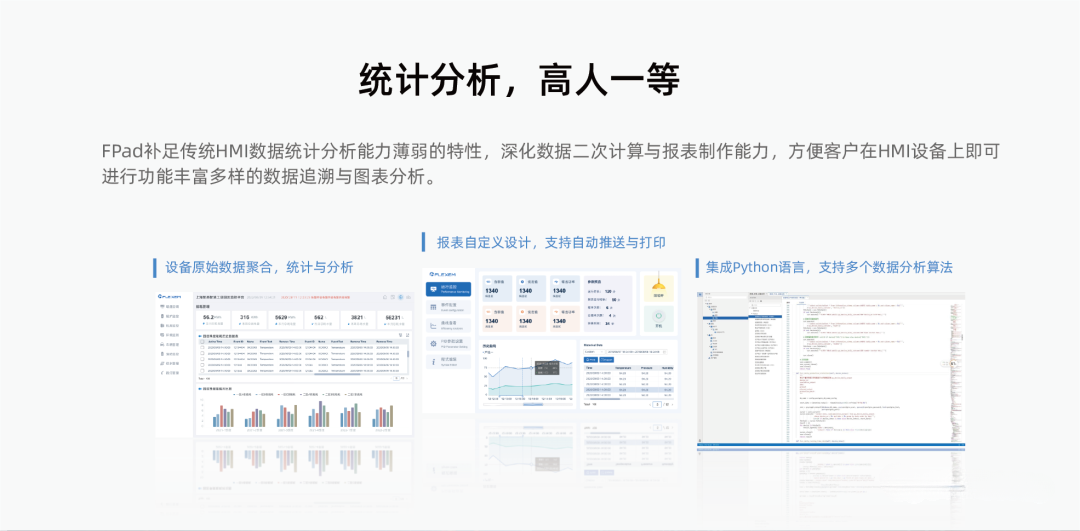
More than just automation, more informationization

Three major application scenarios
1. HMI application solutions for large equipment
Demand background:
- Engineering is difficult to standardize, and repetitive and batch configuration work is difficult to develop quickly
- Projects are difficult to reuse. Equipment models are relatively fixed. Applications need to be quickly replicated at different sites.
- Traditional HMI remote access only supports VNC mode, with poor client expansion capability and cannot support multi-client access on different screens. It is difficult to meet the multi-client access requirements during on-site equipment debugging.
FPad solution value:
-
Equipment program standardization : The digital capabilities of equipment can be quickly replicated at different sites. Through model encapsulation, equipment-related services can be saved for reuse and sharing.
-
Faster HMI development: The development of supporting software for equipment is no longer complicated. The easy-to-use software experience greatly speeds up project development and implementation, allowing companies to quickly acquire software development and implementation capabilities.
-
Upgraded field applications: Functional components such as alarms, operation logs, and recipes assist efficient production on site. The functions are upgraded and optimized compared to traditional touch screens, and support special features such as multi-screen debugging and trend chart multi-variable switching display.
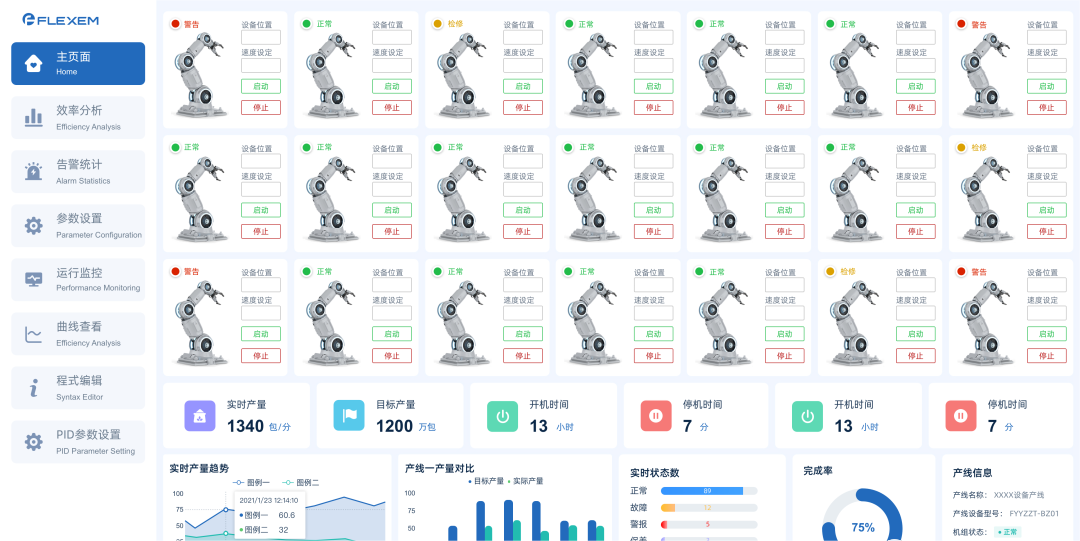
2. Connecting to MES Solution
Demand background:
- The traditional connection path between equipment and MES system is equipment-PLC-industrial computer-MES system. The MES connection program developed by a third party in the industrial computer processes the data pushed by the PLC and passes it to the MES end.
- There is no concept of variables inside the IPC. A mapping between digital numbers and PLC addresses is created. Once the PLC address is changed, the internal program of the IPC needs to be modified. At this time, it is difficult to contact the IPC supplier, the communication cost is extremely high, and the on-site interface management is difficult.
FPad solution value:
-
FPad supports direct connection with MES or other IT information systems, and integrates equipment visualization capabilities. In terms of capabilities, it completely replaces the original HMI+industrial computer functions on site, compresses the architecture, and saves costs.
-
The variable concept is used in FPad, which can be directly mapped with the MES interface parameter field and decoupled from the PLC hardware address. PLC program modification does not affect the MES docking business standards.
-
The Http Soap interface supports one-click parsing, and the interface definition does not require any code writing.
-
Supports functions such as interface disconnection and resumption of transmission.
3. Multi-screen billboard display
Demand background:
-
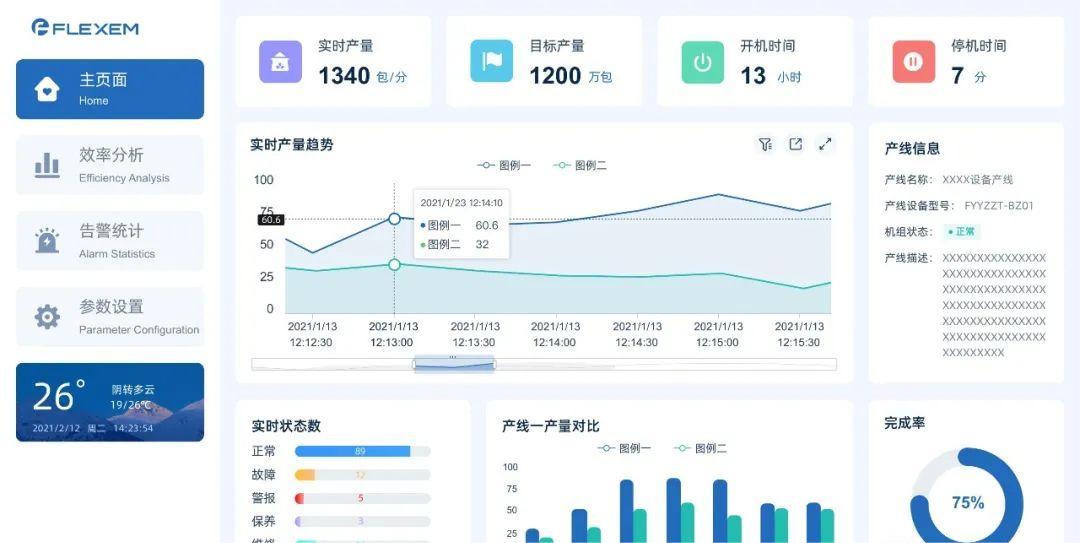
From single equipment to production line integration, a centralized monitoring system is needed, with one dashboard for each production line
-
Only one worker is assigned to a production line, and alarms are recorded in real time.
-
The production line is large and requires multi-screen debugging
-
Large screen display for billboards, traditional touch screens are limited in size
FPad solution value:
FPad hardware supports screen-control separation, and the control box has dual HDMI high-definition interfaces, which can be connected to its own touch screen or other displays. FPad supports mobile phones and tablets to debug the device via the WEB.