

-
Automation and digital product integration providerFV5-U3 Series Full-featured Servo FV5-E Series Direct-Drive Servo FV5-R Series Rotary-Type Servo FV5L Series Gantry-Double-Drive Servo FV3S Series Rotary-Type Servo FV3 Series Rotary-Type Servo FD5 Series Low-Voltage DC Servo High-Voltage AC Servo Motor Low-Voltage DC Servo Motor
-
Automation and digital product integration providerPackaging Industry Electronic Equipment 3C Equipment Semiconductor Industry Machine Tool Industry Photovoltaic Equipment Lithium Battery Equipment SCADA
-
Automation and digital product integration provider
-
Automation and digital product integration provider
Pin Insertion Machine
Equipment Intro & Key Indicators
A pin insertion machine is an automated assembly equipment specifically designed for electronic connectors. It is primarily used to precisely insert electronic components (such as pins) into the plastic housing of connectors to form complete assemblies, widely applied in the 3C electronics industry.

Process Architecture Diagram

Industry Pain Points & Challenges
Mechanical Limits Cause Speed Alarms
Customers demand a high efficiency of 4 pcs/s, but restricted by the 1:5 reducer structure, the cutting axis following speed needs to reach 6000rpm, which easily triggers "speed error" alarms. Traditional control struggles to overcome this.
High Dynamic Load Torque Overload
During high-speed cutting, motor torque can spike to 3 times its rated value, leading to unstable operation or downtime. This requires extremely high instantaneous overload capability from the servo.
Control Mode Switching Errors
The process involves frequent switching between "Position" and "Torque" modes (e.g., push rod action). Switching from torque to position mode often causes axis disconnections or errors, disrupting continuous production.
Cost Challenges in High-end Replacement
Manufacturers require significant reductions in control costs while maintaining identical high efficiency and stability, posing incredibly strict performance demands on domestic alternative solutions.
Flexem Solution Architecture
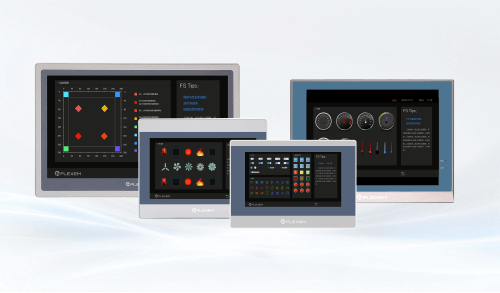
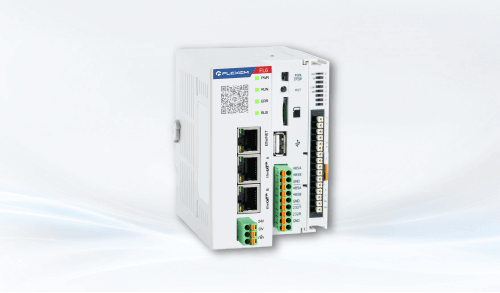
This equipment adopts Flexem's comprehensive automated control solution, utilizing the FE9100WE Series 10.1-inch HMI for human-machine interaction, powered by the high-performance FL8 Series PLC (pulse-axis type FL8-E16-D with expansion modules). The underlying drive layer deploys 11 FV5-R1 Series servo drives (100W-750W). The entire system relies on Codesys tag communication for seamless integration, perfectly meeting the high-speed and high-synchronization demands.

Core Advantages
Process Optimization Breaks Speed Bottlenecks
Innovatively optimized the cam curve, modifying the cutting path from "rotation" to "forward-reverse reciprocating" motion. This lowers the motor speed requirement without changing mechanical structures, stably achieving the 4 pcs/s target.
Dual-stage Gain Solves Overloading
Introduced "dual-stage gain" control parameters and optimized the curve to linear segments, effectively suppressing torque peaks during cutting, keeping loads within safe limits, and ensuring stable operation.
Smooth Switching Ensures Zero Faults
Developed dedicated function block logic utilizing Codesys instructions to achieve a seamless handover between torque and position modes, completely eliminating oscillation and error issues during mode transitions.
Cost-Effective & Perfect Replacement
The solution matches the performance of original imported systems perfectly. Leveraging the high synchronization of the EtherCAT bus, it significantly reduces hardware procurement costs, fulfilling the client's goal of "cost reduction without performance compromise."
recommend products

Related Downloads

